


Elbow
Please see the links below for information on elbow anatomy, injuries and surgical treatments. Please also review the patient info tab above to find new patient forms, preoperative instructions, postoperative instructions, and physical therapy guidelines for these procedures.
Elbow Anatomy
The elbow is a complex joint formed by the articulation of three bones –the humerus, radius and ulna. The elbow joint helps in bending or straightening of the arm to 180 degrees and assists in lifting or moving objects.
The bones of the elbow are supported by
- Ligaments and tendons
- Muscles
- Nerves
- Blood vessels
Bones and Joints of the elbow joint:
The elbow joint is formed at the junction of three bones:
- The Humerus (upper arm bone) forms the upper portion of the joint. The lower end of the humerus divides in to two bony protrusions known as the medial and lateral epicondyles which can be felt on either side of the elbow joint.
- The Ulna is the larger bone of the forearm located on the inner surface of the joint. The curved shape of the ulna articulates with the humerus.
- The Radius is the smaller bone of the forearm situated on the outer surface of the joint. The head of the radius is circular and hollow which allows movement with the humerus. The connection between the ulna and radius helps the forearm to rotate.
The elbow consists of three joints from articulation of the three bones namely:
- Humero-ulnar joint is formed between the humerus and ulna and allows flexion and extension of the arm.
- Humero-radial joint is formed between the radius and humerus, and allows movements like flexion, extension, supination and pronation.
- Radio-ulnar joint is formed between ulna and radius bones, and allows rotation of the lower arm.
Articular cartilage lines the articulating regions of the humerus, radius and ulna. It is a thin, tough, flexible, and slippery surface that acts as a shock absorber and cushion to reduce friction between the bones. The cartilage is lubricated by synovial fluid, which further enables the smooth movement of the bones.
Muscles of the Elbow Joint
There are several muscles extending across the elbow joint that help in various movements. These include the following:
- Biceps brachii: upper arm muscle enabling flexion of the arm
- Triceps brachii: muscle in the back of the upper arm that extends the arm and fixes the elbow during fine movements
- Brachialis: upper arm muscle beneath the biceps which flexes the elbow towards the body
- Brachioradialis: forearm muscle that flexes, straightens and pulls the arm at the elbow
- Pronator teres: this muscle extends from the humeral head, across the elbow, and towards the ulna, and helps to turn the palm facing backward
- Extensor carpi radialis brevis: forearm muscle that helps in movement of the hand
- Extensor digitorum: forearm muscle that helps in movement of the fingers
Elbow joint ligaments and tendons:
The elbow joint is supported by ligaments and tendons, which provide stability to the joint.
Ligaments are a group of firm tissues that connect bones to other bones. The most important ligaments of the elbow joint are the:
- Medial or ulnar collateral ligament: comprised of triangular bands of tissue on the inner side of the elbow joint.
- Lateral or radial collateral ligament: a thin band of tissue on the outer side of the elbow joint.
Together, the medial and lateral ligaments are the main source of stability and hold the humerus and ulna tightly in place during movement of the arm.
- Annular ligament: These are a group of fibers that surrounds the radial head, and holds the ulna and radius tightly in place during movement of the arm.
The ligaments around a joint combine to form a joint capsule that contains synovial fluid.
Any injury to these ligaments can lead to instability of the elbow joint.
Tendons are bands of connective tissue fibers that connect muscle to bone. The various tendons which surround the elbow joint include:
- Biceps tendon: attaches the biceps muscle to the radius, allowing the elbow to bend
- Triceps tendon: attaches the triceps muscle to the ulna, allowing the elbow to straighten
Nerves of the elbow joint:
The main nerves of the elbow joint are the ulnar, radial and median nerves. These nerves transfer signals from the brain to the muscles that aid in elbow movements. They also carry the sensory signals like touch, pain, and temperature back to the brain.
Any injury or damage to these nerves causes pain, weakness or joint instability.
Blood vessels:
Arteries are blood vessels that carry oxygen-pure blood from the heart to the hand. The main artery of the elbow is the brachial artery that travels across the inside of the elbow and divides into two small branches below the elbow to form the ulnar and the radial artery.
Conditions

Distal Biceps Rupture
The biceps muscle is located in front of your upper arm. It helps in bending your elbow as well as in rotational movements of your forearm. Also, it helps to maintain stability in the shoulder joint. The biceps muscle has two tendons, one of which attaches it to the bone in the shoulder and the other attaches at the elbow. The biceps tendon at the elbow is called the distal biceps tendon and if there is a tear in this tendon, you will be unable to move your arm from the palm-down to palm-up position.
Tennis Elbow
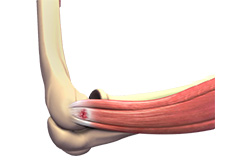
Tennis elbow is the common name used for the elbow condition called lateral epicondylitis. It is an overuse injury that causes inflammation of the tendons that attach to the bony prominence on the outside of the elbow (lateral epicondyle). It is a painful condition occurring from repeated muscle contractions at the forearm that leads to inflammation and micro tears in the tendons that attach to the lateral epicondyle.
Golfer's Elbow (Medial Epicondylitis)
Golfer's elbow, or medial epicondylitis, is irritation and degeneration of the tendons that attach the forearm muscles to the bony bump on the inside of your elbow, called the medial epicondyle.
UCL Injury (Thrower's Elbow)
A UCL injury is a sprain or tear of the ulnar collateral ligament, the band of tissue on the inside of your elbow that connects the upper arm bone (humerus) to a forearm bone (ulna). The UCL resists the strong forces that pull the elbow apart during the late cocking and acceleration phases of throwing.
Elbow Arthritis
Elbow arthritis is wear or damage to the smooth cartilage that covers the ends of the bones in your elbow joint. The elbow is where your upper arm bone (humerus) meets the two forearm bones (radius and ulna). When the cartilage breaks down, the bones may rub, bone spurs can form, and the joint becomes painful and stiff.
Olecranon Bursitis
Olecranon bursitis is inflammation of the small, fluid-filled sac (bursa) that sits between the skin and the bony tip of your elbow, called the olecranon. Normally the bursa is flat and lets the skin glide over the bone. When irritated, it fills with fluid and forms a visible, sometimes painful, swelling. It is sometimes called "student's elbow" or "Popeye elbow."
Elbow Fractures and Dislocations
An elbow fracture is a break in one or more of the bones that form your elbow: the lower end of the upper arm bone (humerus) or the tops of the forearm bones (radius and ulna). An elbow dislocation occurs when these bones are forced out of their normal alignment. The two can happen together, and the ligaments that stabilize the elbow are often injured as well.
Elbow Arthroscopy
Elbow arthroscopy is a minimally invasive surgery in which a small camera, called an arthroscope, and thin instruments are inserted through a few small incisions to examine and treat problems inside your elbow joint. The camera shows the inside of the joint on a monitor, so your surgeon can see the cartilage, joint lining and bone without a large incision.
Tennis Elbow Surgery (ECRB Debridement)
ECRB debridement, also called an ECRB release, is surgery for tennis elbow (lateral epicondylitis) that removes damaged, degenerated tissue from the extensor carpi radialis brevis (ECRB) tendon where it attaches to the outside of your elbow. The ECRB is a forearm muscle that helps steady your wrist when you grip. Repeated strain can cause small tears and painful changes in its tendon that do not heal on their own.
Distal Biceps Repair
Distal biceps repair is surgery that reattaches a torn biceps tendon to its original attachment on the radius, a forearm bone just below your elbow. The biceps helps you bend your elbow and turn your palm up, a motion called supination. When the tendon tears completely, you may lose strength in these motions.